 |
Signature |
 |
Conserve Energy and Save Money
Are your energy bills
too high? Is your home
not as comfortable as
you want it to be? Do
you want to do more to
protect the environment?
Do you have teenagers at
home giving your hot
water bill a beating?
Whatever your situation,
this will help you to
find a solution that’s
right for you. This
guide is primarily aimed
at homeowners who are
thinking of upgrading or
replacing their home’s
existing heating or
cooling systems. It also
contains useful
information for people
who are having a home
built for them, and for
those who want to reduce
their energy consumption
in general.
While builders generally
offer a standard heating
or heating/cooling
package, upgrades to
more efficient equipment
might be available.
Familiarity with the
different systems, fuel
options, their
comparative prices and
operating costs will
help you to review
upgrade options with
your builder. Remember
to also ask your builder
about other energy
efficiency upgrades,
which can range from
extra insulation to a
complete
R-2000-certified home.
Before being
R-2000-certified, each
home is evaluated and
tested to ensure a high
level of energy
efficiency has been
designed and built into
it. There are both
financial and
environmental benefits
to conserving energy and
using it wisely. To help
you conserve even more,
this will also direct
you to resources that
can help you reduce
energy consumed for
purposes beyond heating
and cooling your home.
A Wise Choice
The options presented
will help you to select
heating and cooling
systems that meet the
needs of both your
lifestyle and your check
book. Besides the
obvious savings for you
that occur by lowering
your consumption, by
reducing demand for
energy through
conservation or, in the
case of electricity,
even from shifting
consumption to times of
lower demand, together
we can lower the market
price for the energy
that is consumed. The
advantages of investing
in energy efficiency
aren’t only felt within
your family budget– they
are realized in the
cleaner environment that
goes hand in hand with
more efficient systems
and the wise use of
energy.
Before You Start
Putting an
energy-efficient heating
system into a drafty,
poorly insulated house
will reduce your energy
bills. But you’ll notice
a more dramatic saving,
and even make yourself
more comfortable, if you
also make your entire
house more energy
efficient. How? Here are
some ideas…
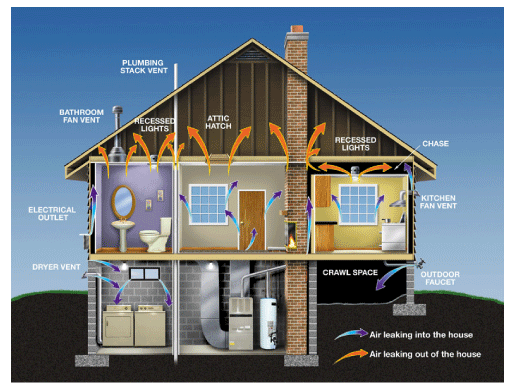
By making your house
more energy-efficient,
your heating and cooling
systems will work less,
and you may reduce the
capacity needed when you
replace your systems,
which means more savings
for you.
Why Energy Efficiency
Matters
It’s good for your
budget, your comfort and
our environment. Each
year you spend hundreds
of dollars to heat and
cool your home and to
heat your hot water. By
installing
energy-efficient
equipment, which gives
you the same comfort for
less energy, you can
lower these costs.
Furthermore, the lower
you can make your energy
costs now, the better
off you will be should
energy prices go up –
and conservation reduces
upward pressure on
energy prices.
Whenever fuels are
burned – in your home,
in a generating station
to produce electricity,
in vehicles or elsewhere
– carbon dioxide,
nitrogen oxide and
sulphur dioxide are
released. These
emissions contribute to
environmental concerns
including smog, acid
rain and climate change.
Reducing energy use
lowers the amounts of
these emissions and
their impact on the
environment. You can
help by practicing
energy efficiency and
conservation not only in
heating and cooling your
home, but everywhere at
home, in the workplace
and in your
transportation choices.
Many
factors can affect your
annual energy bill such
as size and location of
your
home, yearly
variations in weather,
efficiency of your
furnace and other
appliances,
thermostat settings,
number of occupants, and
the local cost of
energy.
Are you serious about
how to go about cutting
your heating and cooling
costs?
Follow these steps:
There are four common
types of heating units:
Most heating systems
need air for combustion.
Furnaces, boilers and
space heaters that burn
fuels need a supply of
air to be able to burn
properly, and a vent to
the outdoors so that
combustion gases can
escape from the house.
Electric heaters do not
need to be vented.
Combustion is a two-step
process: air in, and
gases out.
Air in
In the past, there was
usually plenty of air
leaking into a house to
keep the furnace, boiler
or stove burning well.
Modern homes, however,
are better sealed and
use controlled
ventilation, rather than
uncontrolled leakage, to
provide greater comfort
and energy efficiency.
Vents that supply air
for heating units should
never be blocked. It is
important to ensure that
there is an adequate
supply of combustion air
available, even when
other air exhausting
equipment is in use.
Gases out
Venting used to be done
through a chimney.
Today, however, many
models of natural gas,
oil and propane
equipment can be vented
by pipe directly through
the wall, which greatly
simplifies
installation. Remember
that combustion gases
cannot escape from your
home unless you provide
air to replace them.
That’s why venting
problems can often be
traced to air supply
problems.
Controls
The indoor temperature
is automatically
controlled by a
thermostat. Two
important considerations
are location and type.
Central systems are
normally controlled by a
single thermostat. To
achieve proper
temperature control, the
thermostat must be
located in an area where
it will sense the
“average” indoor
temperature. Locations
exposed to localized
temperature
extremes (outside walls,
drafts, sunlight, hot
ducts or pipes,
etc.) should be avoided.
Different types of
thermostats are
available. Basic types
maintain a fixed indoor
temperature. However,
you can reduce your
heating costs by
installing a set-back
thermostat which can be
programmed to
automatically lower the
temperature when no one
is home or everyone is
in bed, and then warm up
the house before you get
home or wake up. Savings
will vary, but a
set-back of 3ºC for
eight hours daily could
reduce your heating
costs by about 5%.
Where space heaters are
used, each unit will
likely be individually
controlled by its own
thermostat – which is
usually the basic type.
This allows you to keep
unused areas at a lower
temperature than those
areas you do use.
Distribution Systems
There are three types of
distribution systems.
It is important that a
distribution system is
properly designed,
installed and operated
to ensure maximum energy
efficiency and comfort
levels. Try to avoid
placing any part of your
distribution system
outside of your home’s
insulation. This is
sometimes done as a
simple remedy to a
routing problem, but
there is always some
heat loss through the
wall of any distribution
system. It is better
that any losses heat (or
cool) you rather than
your attic.
Forced Air
Registers in each room
can be adjusted to
control the air flow.
Return registers draw
air from the rooms
through separate ducts
back to the furnace to
complete the cycle of
air flow through the
house. Leaks in forced
air distribution systems
are often ignored
because they normally do
not cause any obvious
damage, but it is
important to
avoid/eliminate such
leaks. Leaks will affect
a distribution system’s
ability to provide
comfort in all areas of
the house, and leaks in
some parts of the system
can result in
significant energy loss
and/or
condensation-related
damage which may be
hidden from sight.
Hot water (Hydronic)
Heating
Distributes hot water
from a boiler to
radiators, convectors or
under-floor heating
systems in each room. In
older homes, large
cast-iron radiators are
common. Modern systems
feature smaller boilers,
narrow piping and
compact radiators that
can be regulated to
provide temperature
control in each room.
Under-the-floor heating
systems can be built
into the floors of new
and existing homes.
Space heaters
These have no central
heating unit or
distribution system.
Instead, individual
space heaters – such as
a wood stove, electric
baseboards, radiant
heaters or heaters
fueled with oil, natural
gas or propane – supply
heat directly to the
room. For safety, all
space heaters except
electric ones need to be
vented to the outside.
An appropriately sized
space heater can supply
some heat to all parts
of a home if the design
of the home allows for
natural distribution of
heat from the heater
location. In most cases,
more than one unit is
required to comply with
building code
requirements, but
multiple units allow you
to vary the temperature
around the house.
Energy Sources and
Equipment Options
Natural gas
Furnaces in forced air
heating systems, boilers
in hot water systems,
fireplaces and space
heaters can be fueled by
natural gas. It is
delivered to your house
through an underground
pipeline. (It is not
available in some
areas.)
Propane
Most equipment fueled by
propane is similar to
that fueled by natural
gas. In many cases, the
only differences are one
or two small components
that can often be
changed by a registered
contractor to convert a
unit from one fuel to
the other. Propane is
delivered by truck and
stored in a tank on your
property.
Gas equipment
Because of their
similarities, natural
gas and propane heating
equipment are discussed
together. The term “gas”
refers to both natural
gas and propane. The
cost of the two fuels
differs, so remember to
check for cost
comparisons.
There are three main
types of gas furnaces:
Gas boilers have similar
ranges of seasonal
efficiency.
Older conventional gas
furnaces and boilers
Some older furnaces and
boilers, which are no
longer produced but are
still in use, require a
continuous liner in a
masonry chimney or a
metal “B” vent chimney.
The liner is needed
because the combustion
gases contain water
vapor which condenses on
masonry and causes
deterioration over time.
About 35 per cent of the
heat from the fuel goes
up the chimney with
these models.
Mid-efficiency gas
furnaces and boilers
These models remove more
heat from combustion
gases so that less heat
escapes when the gases
are exhausted and
efficiency is improved.
Depending on the
circumstances, they
might be vented through
a wall or through a
chimney.
High-efficiency
(condensing) gas
furnaces and boilers
These models extract so
much heat from
combustion gases in
order to achieve their
efficiency, that they
can be safely vented
through a narrow plastic
pipe that runs through
the wall.
Gas-fueled fireplaces
Gas fireplaces are
sometimes used to
provide space heating,
though they are often
chosen for aesthetic
reasons. There can be
significant differences
in energy efficiency
from one model
to another, and the
effective efficiency of
some types can be
significantly affected
by how they are used.
Oil
Oil furnaces and boilers
have a burner, a heat
exchanger and a blower
or pump. Oil is
delivered by truck and
stored in a tank, which
is usually located in
the basement.
Older conventional oil
furnaces and boilers
Older, conventional oil
furnaces and boilers
with a standard burner
have a seasonal
efficiency generally
ranging from 60 to 70%.
Like older, conventional
gas furnaces and
boilers, they are no
longer produced.
However, in an existing
model that is working
well, the seasonal
efficiency can be
improved by replacing
the burner with a flame
retention unit – usually
a more cost-effective
step than replacing the
entire furnace.
New oil furnaces and
boilers
A typical new oil
furnace or boiler has a
seasonal efficiency
rating generally ranging
from 78 to 86 per cent.
Many of these units can
be vented through the
wall.
Oil stoves
There are free-standing
oil space heaters with a
visible flame now
available. There are no
efficiency standards for
these products.
Electricity
Electric resistance
systems can consist of a
central furnace or
boiler connected to an
air or hot water
distribution system,
radiant panels embedded
in the floor or ceiling
or a baseboard space
heating system.
Electricity also powers
heat pumps. When
electric resistance
heating is used in a new
home, including as a
back-up for an air
source heat pump, the
building code requires
the house to be built
with higher minimum
levels of insulation.
Heat pumps
A heat pump is usually
an electrically-powered
system that can either
heat or cool by
transferring heat from
one place to another.
During the heating
season, a heat pump
extracts heat from
either the air, ground
or water outside the
house, and transfers it
indoors. In the summer
the direction of the
heat flow is reversed,
extracting heat from
indoors and transferring
it outdoors, to
provide air
conditioning. Because
they satisfy a
substantial part of your
heating needs by
utilizing already
available heat, rather
than consuming
electricity to generate
all of the heat you
need,
heat pumps are
significantly more
efficient than electric
resistance heating.
There are three main
types of heat pumps:
Air source heat pumps
These most commonly-used
heat pumps can provide
all the cooling
requirements of a home
and most of the heating
needs, but they require
an auxiliary heating
source during very cold
weather. This can be
either an electric
resistance or a fossil
fuel unit.
Earth energy systems
Also known as ground
source heat pumps, these
systems transfer heat
from the ground, ground
water or surface water
and use it to provide
home heating. For summer
cooling, the process is
reversed. If desired,
earth energy systems can
be equipped to provide
domestic hot water year
round. Electric
resistance heaters may
be installed to provide
supplementary heating
for the
coldest days.They
normally utilize much
less electric resistance
heat and offer
significantly higher
efficiency than air
source heat pumps.
Wood
Some households use wood
as their main fuel but
even more use it as a
supplementary source of
heat. Most of these
households are outside
large urban areas where
firewood is usually less
expensive than other
fuels. The most common
approach to wood heating
today is a wood stove or
high-efficiency
fireplace installed in
the main living area of
the house. If the house
is
medium-sized and
relatively new, this
kind of equipment can
provide almost all the
heat needed.
If you have an existing
masonry fireplace, a
high-efficiency
fireplace insert could
be a good option. And
many models offer the
pleasure of a visible
wood fire.
Older or larger houses
may need the additional
heating power offered by
a wood-burning furnace.
If your present heating
system is a forced air
furnace that uses a more
costly fuel, you might
want to consider an
add-on wood furnace. It
is installed beside the
existing furnace and the
duct work is modified so
that it can be shared by
both furnaces.
Combination wood/oil or
wood/electric furnaces
are options for new or
replacement systems.
Stoves that burn pellets
made from wood or
agricultural crops such
as corn kernels are also
available. Pellets are
automatically fed into
the burner and the
householder simply dials
in the required
temperature on the
thermostat.
When shopping for
wood-burning equipment,
visit several wood heat
retail stores and
discuss appliance
selection, location and
installation with a
knowledgeable
salesperson.Always buy
wood-burning equipment
that is certified for
safety.
It is
also preferable to buy
equipment that
has been
certified as meeting the
U.S. Environmental
Protection
Agency (EPA) or Canadian
CSA-B415 emission
standards. These
certified wood-burning
appliances produce
one-tenth of the
chimney
emissions and one-third
higher efficiency than
earlier units.
Outdoor furnace
“Outdoor” wood furnaces
or boilers are also on
the market. They may
appear attractive,
because they will burn
low cost material you
would not think of
putting in an indoor
appliance and can burn
for long periods between
refueling. However, they
can be low on efficiency
and high on emissions.
Solar energy
Like wood, solar energy
is a renewable resource.
Solar heating does not
involve the combustion
of fuels, so it does not
produce
environmentally-harmful
emissions. It can be as
simple as south facing
windows serving as
passive solar
collectors. Passive
solar heating is free
and should be an
important consideration
in the design of homes.
Homes built to high
levels of energy
efficiency and designed
to make the most use of
free solar heating can
save hundreds of dollars
a year on energy bills.
Other energy sources
Residential systems are
available to generate
electricity from
sunlight or wind. In
certain situations, such
as remote locations, one
of these may be the most
practical option. In
addition, the government
is establishing
standardized processes
and technical
requirements which will
require electricity
distributors to allow
customers with
qualifying generation
equipment to supplement
their utility
electricity needs with
power they generate
themselves.
Cooling Systems (air
conditioning)
Two types of units cool
an entire house: a
central air conditioner
or a heat pump. If you
only need to cool a
specific area, a window
air conditioning unit
could be your most
energy-conserving
choice. Regardless of
what type you are
considering, remember
that models will vary in
efficiency ratings and
efficiency has a direct
impact on operating
costs, so optimizing
efficiency should be a
priority. Consider
buying an ENERGY
STAR®-qualified model.
Central cooling
If you decide you want
to cool your entire
house, you should
consider which system to
install – central air
conditioning or a heat
pump – when reviewing
your home’s heating
needs. An air
conditioner is actually
a heat pump that can
only cool. *Remember:
your heating decisions
can affect your cooling
options.
Duct work for central
air
Duct work is generally
needed to carry cool air
throughout the house in
a central air
conditioning system. If
you have a forced air
heating system you can
usually use the same
ducts for cooling. If
you do not have duct
work, you can look into
installing it or
consider air
conditioning
technologies that have
been developed for homes
without ducts. These
alternatives are more
costly, so if you are
considering them,
investigate your options
with your
heating/cooling
contractor.
Mini splits
Mini splits are systems
suited to homes without
a central
air-distribution system.
No duct work is
required. The system
consists of two
components: an outdoor
condensing unit, and an
indoor evaporator and
fan. The indoor section
can frequently be
mounted on any interior
or exterior wall, and is
much quieter than a
window unit.
Window units
Window air conditioners
are effective if you
only need to cool a
specific area of your
home. They will cost
less to install than a
central air conditioning
system. If you don’t
have duct work, they
might be your most
practical choice. It is
important to match the
capacity of the window
air conditioner with the
size of the area to be
cooled. Window units
should either be covered
in winter or, better
still, removed to
minimize heat loss.
Other Ways to Cool Your
House
The following measures
will help keep your home
more comfortable:
Storage-type water
heaters
Most homes have
storage-type water
heaters in which water
in a tank is heated by a
gas or oil burner or by
electric elements.
Traditional storage
heaters have been
improved with such
features as
through-the-wall venting
for combustion units and
better insulation,
making them less
expensive to operate.
Units designed to give
even greater efficiency
are now available.
Instantaneous water
heaters
Instantaneous water
heaters which heat water
as needed and have no
storage tank are
available, but not
widely. They require
little space, but they
usually cost more than
storage-type water
heaters and more than
one unit might be
required to meet your
needs. For electric
instantaneous water
heaters, upgraded wiring
is often necessary.
Integrated (combination)
hot water systems
Systems that combine
space heating and water
heating are becoming
more popular. Water can
be heated with a boiler
or a storage-tank water
heater. The hot water
can be used for space
heating as well as
domestic hot water
needs. Space heating
methods include
baseboard radiators,
in-floor radiant heating
and forced air heating
when piped to an air
handler. Some of these
systems can also be used
for pool and spa heating
and snow-melting
applications. Combo
systems vary widely in
efficiency and must be
carefully designed to
give satisfactory
service.
Solar water heaters
In solar water heaters,
energy from the sun is
collected by solar
panels and transferred
by circulating fluids to
a storage tank. These
heaters are typically
used with an electric
water heater, or one
fueled by oil, natural
gas or propane, which
acts as a back-up for
overcast days. Solar
collector panels can be
mounted on any
unobstructed roof, wall
or ground frame that
faces between
southeast and southwest.
Solar water heaters are
designed to provide
between 35 and 75% of
your hot water needs,
with the back-up
providing the balance.
Replacing Your System
Review your options,
consider the pros and
cons of different
equipment and fuels, and
compare installation and
operating costs. Now get
ready to improve your
existing system, and
it’s time to select a
contractor. Here are
some tips:
Prices can vary
significantly among
contractors. Ask each
firm for a written
estimate covering the
following items:
Use costs (both
installed and
operating), work
schedule, warranties and
service as the basis for
your decision. Ask the
contractors you are
considering for
references, and follow
up by contacting
previous customers. Ask
what they think about
the contractor, fuel
supplier and the options
you are considering.
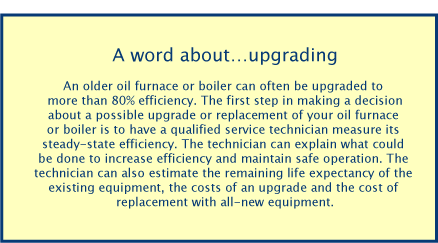
In order to correctly
size new heating and
cooling equipment, your
contractor must analyze
how much heat is lost
from your home in winter
and gained in summer.
Ask for this heat
loss/gain analysis in
writing, including the
method used to perform
the calculation. This
calculation should take
into consideration such
factors as the size of
the house, its level of
insulation and the
condition of windows and
doors. If the heat loss
and gain is significant
and you haven’t already
taken steps to increase
the energy efficiency of
the house, now is the
time to do it.
Avoid the temptation to
simply choose the same
size equipment that
already exists in your
house without doing a
heat loss/gain analysis.
Your home has likely
been altered over the
years
and the system might
even have been the wrong
size at the start. An
oversized unit will
usually operate below
peak efficiency, and
both oversized and
undersized units can
adversely affect the
comfort of your home.
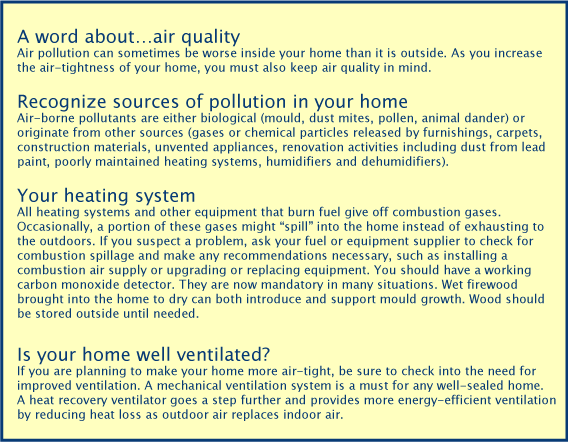
Any installation
involving combustion
equipment should include
steps to ensure that
there will be an
adequate supply of air
for combustion and
venting, and that other
air exhausting equipment
will not cause problems.
Changing Your Water
Heater
Size is an important
consideration when
selecting new hot water
equipment. A larger
family is likely to use
more hot water. A
“downsized” household –
for example, an older
couple whose children
have grown up and moved
into their own homes –
will no longer need a
water heater meant to
supply the needs of four
or more people. By
practicing water
conservation – for
example, by installing
energy-efficient
showerheads and aerators
on taps and using cold
water in your washing
machine – you can
substantially reduce
your hot water usage.
Steps to installing a
hot water tank
Contact your local fuel
supplier or contractor
and ask for the
efficiency ratings of
the models you are
considering. When you
have selected a unit
just big enough to meet
your household needs,
your fuel supplier or
contractor can arrange
for a qualified
serviceperson to install
the water heater. If you
have an electric hot
water tank, wrap it in
an insulating blanket.
Make sure the blanket is
certified for use on
your heater and is
properly installed.
Insulate both the hot
and cold water lines of
the tank and consider
installing a heat trap.
Be careful not to
insulate the pipes too
close to the flue of a
fossil-fueled tank. Ask
your fuel supplier about
any water heating
cost-saving programs
they offer. Some
suppliers do some of the
work at little or no
cost to you.
Glossary of terms
Here is a quick overview
of terms used in this
guide and that you’ll
need to know as you
gather information about
your home heating and
cooling options.
AIR SOURCE HEAT PUMP
A heating-cooling unit
that transfers heat in
either direction between
the air outside a home
and the indoors.
AIR SUPPLY FOR
COMBUSTION
The air that a furnace,
boiler or space heater
requires to burn fuel.
AQUASTAT
A thermostat that
controls the water
temperature in a boiler.
BOILER
The heating unit used
with a hot water
(hydronic) distribution
system.
CENTRAL AIR CONDITIONER
A unit that cools an
entire house by removing
heat from the inside air
and releasing it
outside.
CONTROLS
Devices such as a
thermostat that regulate
a heating or cooling
system.
CONVENTIONAL GAS FURNACE
OR BOILER
A gas heating unit with
an annual fuel
utilization efficiency
(AFUE) less than 70%. It
exhausts through a
masonry chimney (which
should be lined) or
metal “B” vent.
COST-EFFECTIVE
HEATING/COOLING SYSTEM
One that produces good
value for money after
all costs (purchase,
installation, financing
and energy charges) are
considered.
The components of a
heating or cooling
system that deliver
warmed or cooled air, or
warmed water, to the
living space.
DOMESTIC HOT WATER
Hot water used for
household purposes.
EARTH ENERGY
SYSTEM (ground
source heat pump)
A heat pump that
transfers heat from the
earth or ground water in
cold weather and
transfers it to the
house through an
underground piping
system for space
heating, cooling or
water heating. The
process reverses in warm
weather, and heat is
discharged to the ground
or water.
ELECTRICAL RESISTANCE
HEATING
Heat produced by passing
electricity through a
resistor.
FLAME RETENTION HEAD
BURNER
A higher-efficiency
burner in an oil
furnace. It produces a
hotter flame and
operates with a lower
air flow, thus reducing
heat loss up the
chimney.
FLUOROCARBON
REFRIGERANTS
The fluids commonly used
in refrigerating and air
conditioning equipment
to create the cooling
effect. These fluids can
damage the environment.
FORCED AIR
A distribution system in
which a fan circulates
air from the heating or
cooling unit to the
rooms through a network
of ducts.
FOSSIL FUEL
A naturally occurring
carbon or hydrocarbon
fuel such as natural
gas, propane and oil,
formed by the
decomposition of
prehistoric organisms.
FURNACE
A heating unit that uses
a forced air
distribution system.
GROUND SOURCE HEAT PUMP
Another term for an
Earth Energy System.
HEAT EXCHANGER
A structure that
transfers heat from one
gas or liquid to another
gas or liquid. For
example, the hot
combustion gases in a
furnace to the
circulating household
air or, in a boiler, to
the circulating hot
water.
HEAT RECOVERY VENTILATOR
(HRV)
A device used in central
ventilation systems to
reduce the amount of
heat that is lost as
household air is
replaced with outside
air. As fresh air enters
the house, it passes
through a heat exchanger
heated by the warm
outgoing air stream and
is preheated.
HIGH-EFFICIENCY
(condensing) FURNACE OR
BOILER
A heating unit with an
annual fuel utilization
efficiency (AFUE) of 90%
or more. It has a second
stainless steel heat
exchanger that removes
additional heat from
exhaust gases. Water
vapor condenses as the
exhaust cools. The unit
vents through a narrow
plastic wall pipe
instead of a chimney.
HYDRONIC SYSTEM
A distribution system in
which hot water is
circulated through a
network of pipes to
radiators, wall panels
or an under-floor
heating system.
INSTALLED COST
The total of the
purchase price and the
installation costs of
equipment.
INSTANTANEOUS WATER
HEATER
A device that heats
water as required but
does not store it. The
unit is usually located
near the point of use.
INTEGRATED (combo) HOT
WATER SYSTEM
A system that provides
both space and water
heating from a single
heat source.
KILOWATT
A unit of electrical
power used to measure
the heating capacity of
electric equipment. One
kilowatt (kW) equals
1,000 watts (W).
A gas heating unit with
an annual fuel
utilization efficiency
(AFUE) of 78 to 82%.
Some models exhaust
through the basement
wall.
NEW OIL FURNACE
Efficiencies (AFUE)
range from 78 to 86%.
Has flue gases that may
be exhausted through a
chimney or a side wall
vent.
R-2000
A performance standard
for new homes under a
voluntary
government/industry
program. Builders meet
the standard by offering
an integrated package of
features designed to
meet the R-2000
requirements. The
package includes high
insulation levels,
air-tightness, heat
recovery ventilation and
efficient
heating/cooling systems.
RETROFIT
Replacement of one or
more components of an
existing system.
SEASONAL EFFICIENCY
A performance rating
that considers the heat
(or ‘cool’) actually
delivered to the living
space, the total energy
available in the fuel
consumed, and the impact
the equipment itself has
on the total heating or
cooling load through an
entire heating or
cooling season. HSPF,
AFUE, SEER and EF are
seasonal efficiency
ratings.
SEER
seasonal energy
efficiency ratio
SETBACK THERMOSTAT
A programmable
thermostat with a
built-in timer. You can
adjust it to vary
household temperature
automatically.
SPACE HEATER
A heating unit that
supplies heat directly
to the room where it is
located and is not
connected to a
distribution system.
STORAGE-TYPE WATER
HEATER
A tank that heats and
stores hot water.
TON
A measure of the cooling
capacity for central air
conditioners and heat
pumps.
Efficiency Ratings: AFUE,
COP, HSPF, SEER & EER
Take a few moments to
familiarize yourself
with the efficiency
ratings you’ll find on
various pieces of
equipment.
Boilers and Furnaces
Rating to look for: AFUE
The annual fuel
utilization efficiency (AFUE)
of furnaces and boilers
measures their
performance over a
typical heating season.
It takes into account
things like on-and-off
cycles and heat loss
through the chimney or
vent, and is the most
useful furnace and
boiler rating available.
The higher the rating,
the more efficient the
unit.
There is a second
efficiency rating for
furnaces and boilers and
it is known as
steady-state efficiency.
It is higher than an
AFUE rating but it’s not
as helpful. It measures
the equipment’s
performance after it has
been running a short
while and all components
have reached their
normal operating
temperature. The steady
state efficiency of
furnaces and boilers is
determined by
comparing the amount of
heat that’s available in
the fuel to the amount
that is converted into
usable heat, but it does
not include off-cycle
losses.
Wood-burning appliances
Advanced equipment which
is certified as meeting
the EPA or CSA-B415
emissions standard
normally exceeds 60% and
averages 70% efficiency.
Conventional
wood-burning appliances
which are not certified
as low emission average
50% efficiency, with a
range of 35 - 70%.
Although some wood
burning equipment is
specifically certified
for efficiency, most is
not.
Also, most wood-burning
appliances are manually
operated, not automatic,
and so the practices of
the operator will affect
the efficiency actually
achieved.
Heat pumps
Ratings to look for:
COP, HSPF
Earth energy systems are
rated for heating
efficiency by comparing
them to electric
resistance heat. The
measurement used is
called the coefficient
of performance – COP –
and is determined by
dividing the heat output
by the energy input.
Since the COP of an
electric resistance
heater is 1.0 – which
means that the same
amount of energy that
goes into it as
electricity comes out as
heat – any rating higher
than 1.0 means that for
the same amount of
electricity going in,
more heat comes out.
Look for a COP of 3.1 or
more.
The heating efficiency
rating for an air source
heat pump is called the
heating seasonal
performance factor
(HSPF). This is
determined by dividing
the total heat provided
during the season (in
BTU) by the total energy
consumed by the system
(in watt-hours). The
higher the rating, the
more efficient the heat
pump is over the entire
heating season. Look for
an HSPF of more than
5.9.
Air conditioners and air
source heat pumps
Ratings to look for:
SEER
A SEER rating, which
stands for Seasonal
Energy Efficiency Ratio,
tells you the cooling
energy efficiency of air
conditioners and air
source heat pumps. The
rating is determined by
dividing the total
cooling provided during
the season (in BTU) by
the total energy
consumed by the system
(in watt-hours). The
higher the rating, the
more energy-efficient
the unit. SEERs for new
central air conditioners
and air source heat
pumps currently range
from 10 to 17. For room
air conditioners, the
range is 8 to 12.
Earth energy systems
Ratings to look for: EER
If you want to know how
efficiently an earth
energy system can cool,
look for the letters
EER, which stand for
energy efficiency ratio.
EER ratings are
determined by dividing
the cooling output of
the ground or water
source heat pump (in
BTU/hour) by the power
input (in watts). Look
for an EER of at least
10.5.
Hot water equipment
Storage-type Hot Water
Heaters
An energy factor (EF) is
used to rate the energy
efficiency of
storage-type hot water
heaters. Both on-cycle
efficiency and off-cycle
losses are taken into
account, which makes it
a seasonal rating. The
higher the EF, the more
efficient the unit. You
can expect the following
energy factor ranges for
new storage-type water
heaters:
A storage-type water
heater added to an earth
energy system will
normally have an energy
factor of 2.7 to 3.1.
For the best inspector
in your neighborhood
visit
www.InspectorLocator.com
or call 1-877 FIND-INS.
|
|
|
|
|
|
George Timmerman CHI - CMIA* 280 Kemp RD * Suwanee GA 30024 * (470) 545-9824 |