 |
Signature |
 |
Economic Benefits Of Runoff Controls
People have a strong
emotional attachment to
water, arising from its
aesthetic
qualities--tranquility,
coolness, and beauty. As
a result, most water
bodies within
developments can be used
as marketing tools to
set the tone for entire
projects. A recent study
conducted by the
National Association of
Home Builders indicates
that "whether a beach,
pond, or stream, the
proximity to water
raises the value of a
home by up to 28
percent." A 1991
American Housing Survey
conducted by the
Department of Housing
and Urban Development
and the Department of
Commerce also concurs
that "when all else is
equal, the price of a
home located within 300
feet from a body of
water increases by up to
27.8 percent" (NAHB,
1993).
Although there are a
limited number of
natural waterfront sites
adjacent to lakes,
rivers, streams,
estuaries, or open
ocean, many
opportunities exist to
create waterfront
property. Homes and
businesses can be sited
along hydroelectric or
water supply
impoundments or near the
banks of artificial
lakes created for
wildlife, recreational,
or aesthetic reasons. A
practice becoming more
prevalent is to site
developments around
man-made ponds, lakes,
or wetlands created to
control flooding and
reduce the impacts of
urban runoff on
neighboring natural
streams, lakes, or
coastal areas. When
designed and sited
correctly, artificial
lakes or wetlands can
help developers reduce
negative environmental
impacts caused by the
development process and
increase the value of
the property. Certain
urban runoff management
controls can be
incorporated into a
development in a way
that provides aesthetic
and economic benefits.
Urban runoff controls
that are pleasing to the
eye and safe for
children can lead to
increased property
values. Because the
beauty of natural
surroundings can
increase real property
values and enhance the
quality of life,
beautification of land
areas adjacent to
waterways and detention
ponds should be
considered an integral
part of planning by
developers. For
existing runoff controls
that are unsightly,
corrective renovations
can be made to increase
the property value and
quality of life.
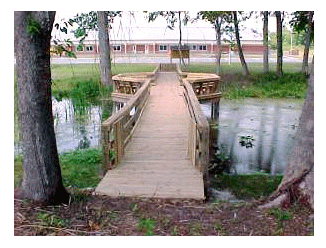
Impacts and Controls
Development leads to an
increase in the amount
of pollutants in an
area. Sediment from
construction sites can
end up in streams and
rivers, choking plant
and animal life. Oil and
gas from vehicles can
leak onto roads and
parking lots.
Fertilizers and
pesticides, if not
applied properly, can
wash off lawns.
Pesticides are often
found in higher
concentrations in urban
areas than in
agricultural areas. Pet
waste, if not properly
disposed of, can enter
storm drains that lead
to wetlands, streams, or
rivers. Household
chemicals, such as
paints and cleaning
products, can leak if
not stored or disposed
of properly. All of
these pollutants can
wash away when it rains
and end up in streams,
rivers, lakes,
estuaries, or ground
water. Many pollutants
also bind to the
sediment, so when
sediment washes away it
takes the pollutants
with it.
Urbanization also leads
to loss of pervious
areas (porous surfaces)
that allow rainwater to
soak into the ground.
This can increase the
amount and velocity of
rainwater flowing to
streams and rivers. This
increased speed and
volume of water can have
many impacts, including
eroded stream banks,
increased turbidity and
pollution, increased
stream water
temperature, and
increased water flow.
All of these can have an
adverse effect on the
fish and other organisms
living in the stream and
the receiving waters.
When rainwater cannot
soak into the ground,
the result can be a loss
of drinking water
because many areas of
the country rely on
rainwater soaking into
the ground to replenish
underground drinking
water supplies. Loss of
trees due to
urbanization can have
negative impacts.
Trees are important for
controlling the water
temperature along the
shorelines of water
bodies. Since many
aquatic plant and animal
species are sensitive to
changes in water
temperature (trout, for
example), it is
important to keep stream
temperatures as close to
natural levels as
possible. When the shade
of trees is lost, the
water temperature can
increase. "Best
management practices,"
or BMPs, help address
these impacts. BMPs are
designed to help reduce
the amount of pollution
in urban runoff. Some
help to control the
volume and speed of
runoff before it enters
receiving waters. Many
help to increase the
amount of rainwater that
soaks into the ground to
restore groundwater.
There are two general
types of BMPs:
structural and
nonstructural.
Structural controls
involve building at
"facility" for
controlling urban
runoff. There are a
variety of structural
controls and most
require some level of
routine maintenance.
There are two types of
structural controls that
have been documented as
providing economic
benefits: urban runoff
ponds and constructed
wetlands. Nonstructural
BMPs do not require
construction of a
facility. For example,
planning a development
so that there are
buffers along stream
banks and minimizing the
amount of impervious
area are types of
nonstructural controls.
Structural and
nonstructural controls
can be used in
combination to manage
runoff. Urban runoff
management controls are
now widely accepted due
to lessons learned from
not planning properly
for the impacts
associated with
increased urbanization.
Most local governments
require some form of
urban runoff management
for new development.
They require such
controls for two
reasons: to prevent
pollution and to prevent
flooding caused by
increased runoff, mostly
from impervious areas.
Usually they require
structural controls
although some local
governments give credit
for nonstructural
controls.
Methodology
A literature review was
conducted to examine the
impacts of urban runoff
management ponds on
property values. Many
experts in the real
estate field and experts
involved in management
of urban BMPs/runoff
controls were contacted.
Discussions with
organizations including
the Urban Land
Institute, the American
Planning Association,
and the National
Association of Home
Builders proved valuable
in identifying
developments that have
incorporated urban
runoff management
requirements into site
development and have
realized an economic
benefit. Regional
personnel of the U.S.
Environmental Protection
Agency (EPA) were
contacted and provided
information on their
region of the country as
well as potential case
study examples.
Developers and realtors
provided comparative
values and information
on premiums charged for
various properties
nationwide.
Information regarding
case studies was
compiled through
literature reviews, site
visits, and discussions
with developers and
realtors. After the
information- gathering
process was completed,
case studies were
selected. The case
studies are
representative examples
of positive economic
impacts on new
development, existing
development, and
commercial property.
Conclusions were made
based on information
gathered and discussions
with experts in the
fields of real estate
and urban runoff
controls.
Ponds and Wetlands for
Urban Runoff Control
Wet Ponds
Wet ponds, as their name
implies, are runoff
holding facilities that
have water in them all
the time. Storm flows
are held in the pond
temporarily and then
released to maintain
healthy downstream
habitats. Sediment and
other pollutants settle
out of the water and are
not discharged to the
receiving waters. Wet
ponds are usually
vegetated, and the
plants' roots hold
sediment and use the
nutrients that are often
contained in urban
runoff. The ponds are
designed to be big
enough to control onsite
and offsite flooding in
the event of a major
storm. This helps to
control impacts on
downstream habitats.
Many of the "lakes" in
developments are
actually detention or
retention wet ponds.
Developers can design
the wet ponds to look
like natural lakes. Wet
ponds can be highly
effective in removing
sediment and in reducing
nutrients if they are
properly constructed and
maintained. They can
usually be used for
large drainage areas.
Wet ponds can be
incorporated into new
development site plans
and can enhance the
value of surrounding
property. Old wet ponds
can also add value to
the surrounding property
once they have been
aesthetically improved.
Constructed Wetlands
Wetlands serve an
important function in
controlling the impacts
of urban runoff. Because
wetlands are heavily
vegetated, they serve as
a natural filter for
urban runoff. They also
help to slow the
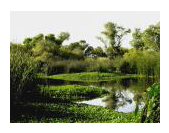 flow of water to the
receiving waters and
replenish groundwater.
When properly designed,
constructed wetlands
have many advantages as
an urban BMP, including
reliable pollutant
removal, longevity,
adaptability to many
development sites,
ability to be combined
with other BMPs, and
excellent wildlife
habitat potential (MWCOG,
1992).
flow of water to the
receiving waters and
replenish groundwater.
When properly designed,
constructed wetlands
have many advantages as
an urban BMP, including
reliable pollutant
removal, longevity,
adaptability to many
development sites,
ability to be combined
with other BMPs, and
excellent wildlife
habitat potential (MWCOG,
1992).
Making Urban Runoff
Management Work for You
In many cases,
developers are able to
make quicker sales and
additional profits from
units that are adjacent
to a wet pond. If the
urban runoff management
control is also
developed to allow
passive recreation
(e.g., a walking path
around a lake or pond),
the recreational area
and the wet
pond/constructed wetland
can become the feature
attraction when
advertising the
property. Adding walking
trails, fitness
equipment, gazebos, bird
houses, and other
facilities to enhance a
detention area can be
costly, but eventually
additional profits are
realized (Sala, 1995).
The impacts of urban
runoff management
controls on property
values are site-specific
(CDM, 1982). Controls
can affect property
values in one of three
ways: increase the
value, decrease the
value, or have no
impact. "Urban runoff
controls are greeted
with varying degrees of
skepticism and
acceptance by
residential versus
commercial property
owners," according to
Judith Costello Pearson,
Manager, Market
Research, Fairfax County
(Virginia) Economic
Development Authority.
One must consider the
appeal of an attractive
urban runoff management
control along with the
liability of open water.
A childless adult might
perceive a wet pond as
an amenity, but a family
might view it as a
potential hazard to
children.
Factors That Lead to
Increases in Property
Value
Runoff from the Hyatt
Regency Ravina hotel
complex in Atlanta,
Georgia, flows into a
series of beautifully
designed wet ponds
linked together by
streams and waterfalls
that are kept flowing by
recirculating pumps. A
carefully designed wet
pond at the Woods in
Rhinebeck, New York,
provides flood control
and water quality
benefits, and the
waterfront created by
the impoundment enhances
the value of surrounding
townhouses (NYSDEC,
1992).
Factors That
Lead to Decreases in
Property Value
Residential lots located
near an urban runoff pond
are often a concern to home
buyers with young children.
Parents fear their children
will be attracted by the
water or wildlife and drown.
Incidents of drowning in
urban runoff management
areas have occurred in
residential as well as
commercial areas. Children
who fall through frozen
ponds or fall into the water
without knowing how to swim
are usually the victims.
Adults have also drowned in
detention ponds. A Chicago
man fell into an
18-foot-deep retention pond
located on the property of a
junkyard and drowned.
According to one real estate
appraiser, safety is the
only issue regarding urban
runoff management controls
that adversely affects
property value (Jablonski,
1995).
One solution is to
construct a fence
surrounding the pond to
deter entry and reduce
accident potential.
Chain-link fencing is
often used. Rusting,
poorly maintained
chain-link fencing
reduces any aesthetic
qualities of the area,
but fencing that has a
black or green
protective coating is
more attractive and can
improve the appearance
of the runoff control. A
"protective device" of
the developer's choice
must be placed around
ponds near residential
areas with over 2 feet
of standing water or
more than 2 hours of
drainage time. The
protective device may be
fencing or plantings of
bushes and trees; in
some cases, flat slopes
or shallow beaches
extending at least 20
feet from the perimeter
of the pond are
acceptable. These flat
slopes or beaches
provide protection for
children who could roll
down steep slopes
directly into the pond.
Using flat slopes
reduces the amount of
land available for
development, however,
and is the least used
option. Fencing is the
most inexpensive
solution and is used
frequently. It has been
reported to be an
"attractive nuisance,"
however, because some
older children feel
challenged to climb
fences and enter
restricted areas.
Requirements to
construct wet ponds for
urban runoff management
are a concern for
developers, who lose the
potential profit from
this otherwise buildable
land.
This unrealized profit,
or foregone value, can
be substantial if, for
example, a builder is no
longer able to construct
several planned
townhomes (Rolband,
1995). Developers often
increase the number of
homes built in the area
available for
development and reduce
the size of individual
homes to recoup the
foregone value of the
property.
Poorly maintained wet ponds
or constructed wetlands are
often unsightly due to
excessive algal growth or
garbage build-up. These
conditions are considered
detriments by area residents
and people passing through
the areas. Wet ponds and
constructed wetlands can
also become mosquito
breeding grounds. Mosquito
problems usually can be
reduced or eliminated by
designing the wet pond so
that all portions of the
basin are connected to open
water to allow natural
predators to control the
mosquito larvae (Tourbier
and Westmacott, 1992).
Generally mosquitoes are not
a problem in the presence of
a good biological community.
Organic controls such as
mosquito-eating fish or
insecticidal bacteria like
Bacillus thuringiensis
israelensis (Bti), however,
are also options where
mosquitoes need to be
controlled.
Improving the
Acceptance of Urban
Runoff Facilities
Effective landscaping can do much to overcome the disadvantages of urban runoff systems and improve the appearance of facilities. Banks of urban runoff storage areas and drainage ditches should be graded smoothly into adjacent areas where feasible. Steep slopes should be protected against erosion by stabilization techniques, such as gabions, rip-rap, or other practices that detract as little as possible from the natural setting. Planting and preservation of trees, shrubs, and other vegetation should also be a part of the improvement plan (Poertner, 1974). Sediment accumulation and waterlogging of otherwise usable land areas can be avoided by the use of proper design, construction, and operation techniques. Ponds used for urban runoff control can be spared from excessive sediment accumulation by the use of forebays for silt collection. The amount of silt transported can be reduced by directing runoff through vegetated areas or specially designed runoff filters. Waterlogging of land surrounding urban runoff storage areas can be minimized by sloping the ground toward storage areas, eliminating water pockets, and minimizing the frequency and duration of ponding on areas otherwise suitable for multipurpose use (Poertner, 1974).
Operation and
Maintenance
Wet ponds and constructed
wetlands require periodic
maintenance to preserve
environmental and monetary
benefits of "waterfront"
lots. However, the benefits
of higher resale value and
quality of life typically
outweigh the combined costs
of the initial lot premium
and annual maintenance fees
charged by homeowners'
associations. In fact,
operation and maintenance
costs of urban runoff
retention ponds can be as
low as $62 per year for
homeowners (MWCOG, 1983).
Case Studies
The following case studies
highlight developments where
the incorporation of urban
runoff controls resulted in
economic benefits to the
local homeowners or
developers. The case studies
detail how the presence of
aesthetically designed
runoff controls affected
both the initial sale value
of new developments and the
resale values for existing
developments.
New Development
A
landmark survey by the
National Institute for
Urban Wildlife indicated
that 75 percent of the
residents of Columbia,
Maryland, a community
planned for a population
of 100,000, prefer urban
runoff ponds that
contain permanent pools
of water, wetlands, and
wildlife over the dry
ponds many
municipalities prescribe
for their subdivisions.
Residents (94 percent)
overwhelmingly believed
that managing future
runoff basins for fish
and wildlife as well as
for flood and sediment
control would be
desirable. Residents (92
percent) considered the
view of birds and other
wildlife to be
particularly important
and felt that the sight
of them outweighed any
nuisances they created.
Perhaps most
importantly, 75 percent
of
Columbia homeowners felt
that permanent bodies of
water added to real
estate values and 73
percent said they would
pay more for property
located in a
neighborhood with storm
water control basins
designed to enhance fish
or wildlife use. The
study in Columbia
covered an area that
contained 3 lakes, 22
runoff ponds with a
permanent pool of water,
and 9 dry detention
basins (Adams et al.,
1984; Tourbier and
Westmacott, 1992).
Residents of seven
Champaign-Urbana, Illinois,
subdivisions with urban
runoff detention ponds were
questioned about the role
the pond played in their
decision to purchase their
home. Sixty-three percent of
the respondents living
adjacent to a wet pond
identified the pond as what
they liked most about their
neighborhood. Seventy-four
percent of homeowners
surveyed believed that wet
ponds contributed positively
to the image of a
subdivision as a desirable
place to live. Only 3.5
percent felt a wet pond had
a negative influence on the
image of their neighborhood.
Overall, respondents
believed that lots adjacent
to a wet pond were worth an
average of 21.9 percent more
than comparable nonadjacent
lots in the same
subdivision. Eighty-two
percent of all respondents
said they would, in the
future, be willing to pay a
premium for a lot adjacent
to a wet pond (Emmerling-DiNovo,
1995).
Built in 1993, the Sale
Lake subdivision of
single-family homes
surrounds a 4-acre
constructed wetland.
Sale Lake demonstrates
environmental
sensitivity in suburban
development. Lots
located alongside the
wetland sold for as much
as $134,000, up to a 30
percent premium over
lots with no water view
(St. Germain, 1995).
Highland Park, Illinois
"Preservation is not a
problem for developers;
it's a golden
opportunity," insists
the president of the
development company for
Hybernia, a community of
122 single-family houses
on a 133.5-acre site in
Highland Parks,
Illinois. The site,
zoned for
40,000-square-foot lots,
was laid out around a
constructed pond/stream
system and 27 acres of
land approved as a state
nature preserve. The
site includes 16.5 acres
of ponds. Forebays at
urban runoff inlets
catch sediments
(Tourbier and
Westmacott, 1992).
Hybernia is a an example
of ecological landscape
planning. Waterfront
lots, which now sell for
$299,900 to $374,900,
draw a 10 percent
premium above those with
no water view (Margolin,
1995).
Virginia Chancery on the
Lake, a condominium
development in Alexandria,
Virginia, is a residential
project with an attractive
14-acre urban runoff
detention area. Realtors are
currently promoting the wet
pond as the development's
feature selling point. The
wet pond will be surrounded
by a walking trail, and a
gazebo and fishing pier will
also be built. According to
Ginger Harden, Sales
Associate of Chancery
Associates LP, condominiums
are priced between $129,990
and $139,990. Condominiums
that front the lake are
selling at a $7,500 premium.
For the first four buildings
on the market, a $5,000
premium was charged for
units fronting the lake. The
lakefront units were the
only units selling, and now
the premium has been raised
to $7,500 (Harden, 1995).
A development consisting
of apartments and
townhouses in St.
Petersburg, Florida,
Lynne Lake Arms, has
four urban runoff
detention ponds on site.
Three of the ponds are 3
to 5 acres in size, and
the fourth is a 25-acre
pond with a large
fountain in the center.
Apartments or townhouses
rent for between $336
and $566 a month. Units
facing the three smaller
ponds have a $15 per
month waterfront
premium; units facing
the large pond are
rented at a $35 per
month premium (McInturf,
1995). A small channel
connects the large
detention pond and one
of the smaller ponds.
Even apartments fronting
this channel have a $5
per month waterfront
premium.
The owner of a 72.3-acre
parcel of land had plans to
fill deteriorating wetlands
before building a
subdivision. He was
persuaded to enhance them
instead and now promotes
enhanced and constructed
wetlands as the feature
selling point of The
Landing. A lake with 3,750
feet of shoreline provides
aesthetic and recreational
value, as well as sensible
detention of urban runoff.
Waterfront lots currently
sell for $18,000 to $40,000,
a premium of up to $21,000
(150 percent) above
comparable lots with no
water view (Baird, 1995).
Existing
Development
Since
their construction in
1971, units facing the
constructed pond in the
townhouse community of
Pinewood Lakes have sold
at a premium. Of the 497
units, all with exactly
the same square footage
according to tax
records, only 20 have
direct water views in
either the front or the
rear. Figures show the
average 1994 sales price
of townhouses lacking
the water amenity to be
$93,833. The average
waterfront sales price
is $100,000, a premium
of $6,117. Higher sales
prices for properties
with views of the water
have been consistent for
23 years (Wade, 1995).
Evans Mills is an
upscale community of 41
townhouses in the Tysons
Corner area built around
an existing pond.
Fairfax County tax
records show Evans Mills
waterfront townhouses
sell at higher prices.
In 1994, waterfront
homes sold for an
average $17,467 premium
above the average
$419,200 price of homes
not facing the pond
(Wade, 1995).
Single-family homes can
have higher initial sale
values as well as higher
resale values when they
face urban runoff
detention areas. County
tax records reveal that
land values in Franklin
Farms, an established
residential neighborhood
in northern Virginia,
are highest when located
in view of its 5-acre
urban runoff detention
area, which is
surrounded by a walking
path furnished by the
developer. "Waterfront"
homes in this
neighborhood sold for 10
to 20 percent more
initially and again at
resale than land with no
water view (Downham,
1995). (These
percentages might be
slightly higher than
actual premiums due to
possible additional
amenities in the
waterfront homes.)
Commercial
Property
Laurel Lakes Executive
Park, commercial
property in Laurel,
Maryland, also has
created an attractive
wet pond system. Office
space fronting the water
rents at a premium of
$100 to $200 per month
depending on the size
and layout of the office
space (Kalish, 1995). On
average, first-class
office space located in
Prince George's County
with a lakefront view
rents for between $17.50
and $20.00 per square
foot, whereas properties
without a view rent for
between $16.50 and
$18.50 per square foot
(Duncan, 1995). Fairfax
County, Virginia
Commercial office space
also can be valued
higher when it fronts
aesthetically designed
runoff retention ponds.
The lakefront Lakeside
at Avion and Tysons
Pond, both located in
Fairfax County,
Virginia, are examples
of commercial projects
that took advantage of
the requirement to
implement urban runoff
management controls by
enhancing a retention
pond and then
capitalizing on the
presence of the pond
when naming the project.
In Fairfax, Virginia,
the average cost of
commercial office space
without water as an
amenity is approximately
$15 per square foot. The
average leasing rate for
commercial waterfront
office space is $16 per
square foot (Constam,
1995; Goeller, 1995). In
a soft commercial real
estate market, where
office space is
overabundant, it can be
difficult to ask for a
premium of any kind.
However, real estate
brokers agree that, when
all else is equal,
commercial waterfront
property rents
considerably faster than
space that does not
front water (Berman,
1995; Constam, 1995;
Goeller, 1995; Pepper,
1995). Although a tenant
might not be charged for
a water amenity, it can
provide a steadier flow
of income and fewer
vacancies for the
realtor (Berman, 1995).
Mike Pepper, Vice
President of CB
Commercial Real Estate
Group, Inc., declares
that "There is
absolutely a premium
associated with
commercial lakefront
property. Anything
adding to the aesthetic
value is going to raise
a property's value." Mr.
Pepper concedes that in
the saturated market of
northern Virginia,
property with a water
view might or might not
rent for a $1-$3 per
square foot premium, but
will always sell or be
rented more quickly
(Pepper, 1995).
Conclusion
Environmental benefits are
not the only valid reason
for encouraging developers
to incorporate urban runoff
controls into new
residential and commercial
developments. Increased
property values can result
from aesthetically
landscaped controls. Both
homeowners and developers
have realized benefits from
beautification of areas
adjacent to waterways and
detention ponds. Residents
find the beauty and
tranquility of water, as
well as fish, birds, and
other wildlife, highly
desirable. The beauty of
natural surroundings
increases real residential
property values by up to 28
percent while also enhancing
the quality of life.
Commercial property owners,
too, can benefit when their
property is adjacent to an
aesthetically designed urban
runoff control. They can
realize lower vacancies,
lower tenant turnover, and
high rental prices. Real
estate professionals agree
that the more amenities a
property has, the faster it
will sell or rent. Of
course, to maintain higher
property values, aesthetics
must be considered during
the operation and
maintenance of wet ponds and
constructed wetlands over
the years.
Glossary of
Terms
Best management
practice (BMP): A
practice or combination of
practices that are
determined to be the most
effective and practicable
(including technological,
economic, and institutional
considerations) means of
controlling point and
nonpoint source pollutants
at levels compatible with
environmental quality goals.
Impervious area:
A hard surface area
(e.g., parking lot) that
prevents or retards the
entry of water into the soil,
thus causing water to
run off the surface in greater
quantities and at an
increased rate of flow.
Nonpoint source
pollution: Water
pollution caused by rainfall
or snowmelt moving over and
through the ground which
carries pollutants. A
nonpoint source is any
source of water pollution
that does not meet the legal
definition of point source
in section 502(14) of the
Clean Water Act.
Wet pond:
Pond for urban runoff
management that is
designed to detain urban
runoff and always
contains water.
For the
best inspector in your
neighborhood visit
www.InspectorLocator.com
or call
1-877 FIND-INSP.
|
|
|
|
|
|
George Timmerman CHI - CMIA* 280 Kemp RD * Suwanee GA 30024 * (470) 545-9824 |